E-Commerce · Gifting
Gift Cards
A two-week fake door test that turned a cart abandonment problem into an $81K monthly revenue opportunity.
Role
Product Manager
Timeline
Q4 2023
Platform
Web
The opportunity
Our platform connected sellers with buyers for custom merchandise, but we had a cart abandonment problem. As our team shifted focus toward increasing buyer revenue, gift cards surfaced as a high-potential idea — one that could convert hesitant shoppers and open up entirely new purchase occasions like gifting.
The catch: building a full gift card system would take 4 to 6 months. Before asking for that investment, I wanted to know if buyers actually wanted this. So instead of debating hypotheticals, we ran an experiment.
The fake door test
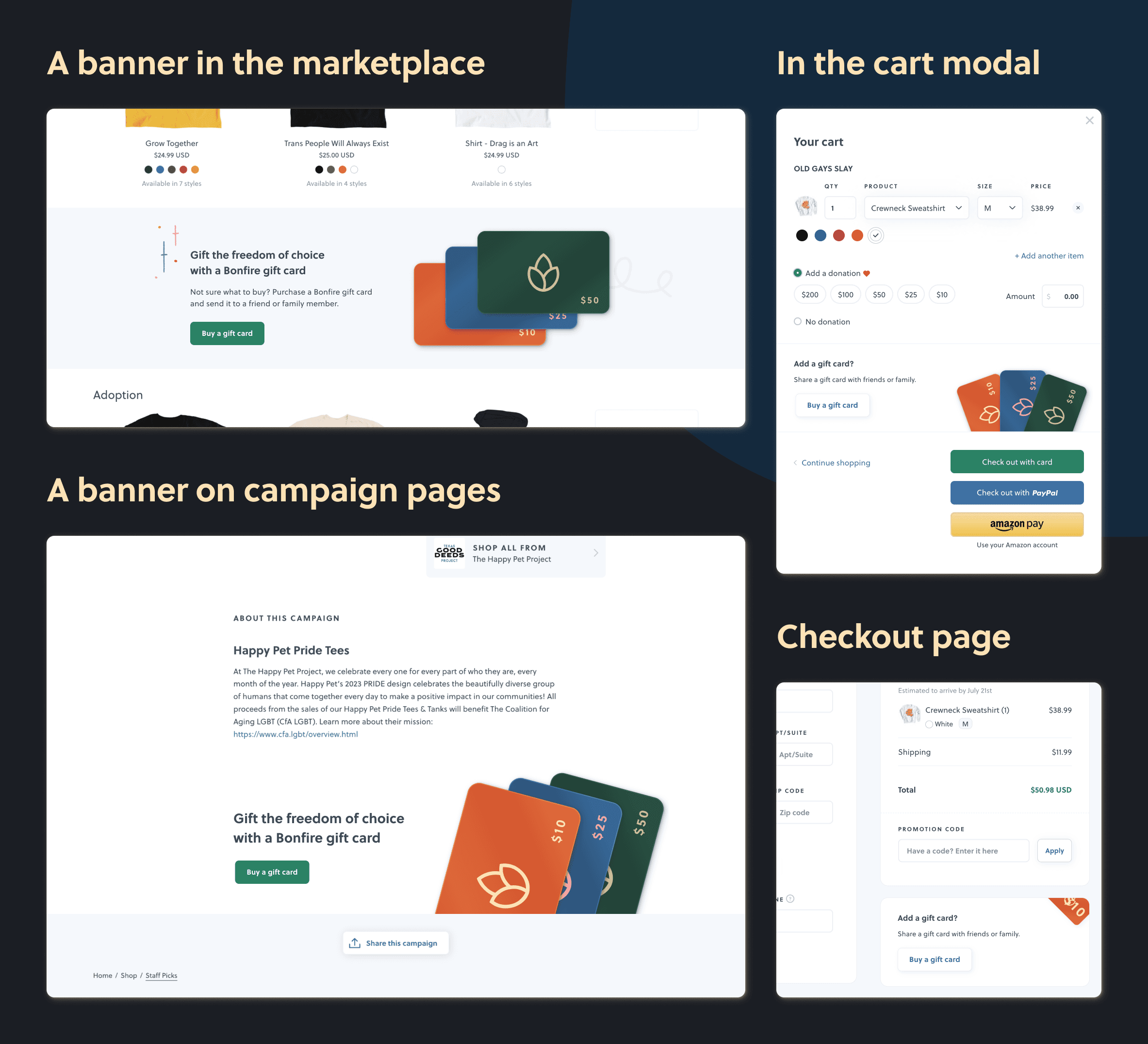
We designed a two-week "fake door" experiment: gift card ads placed across six high-traffic locations on the platform. When clicked, users could select a gift card amount and add it to their cart. After submitting, they saw a message that the feature was under construction. No real functionality, but real signal.
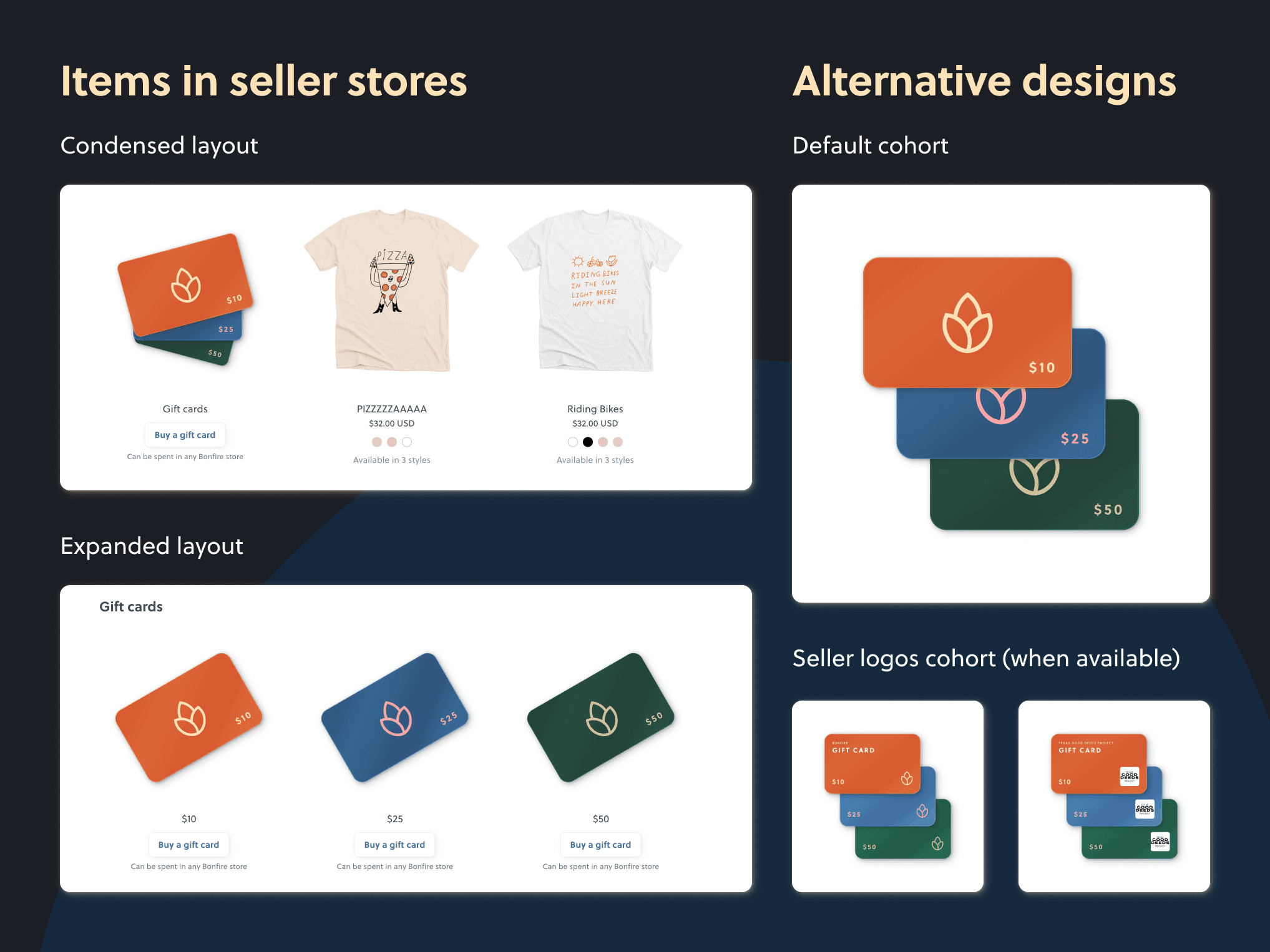
We split users into three cohorts: a control group, a Bonfire-branded gift card group, and a seller-branded gift card group. Our success threshold was 1% conversion on the ads. Our sample was 875,852 unique users.
Of the 294 users who clicked 'add to cart' on the gift card modal, only 40 went on to complete a purchase anyway. That meant roughly 254 people showed real purchase intent and walked away empty-handed.
Overall conversion came in at 0.8%, close to but just under our threshold. The campaign cart placement hit 1.1%, exceeding it. At an average intended gift card value of $160, that translated to an estimated $81,280 in monthly revenue we were leaving on the table.
One finding I didn't expect: seller-branded cards consistently outperformed Bonfire-branded cards across placements. Buyers weren't looking for generic platform credit. They wanted to support specific sellers and campaigns. That insight directly shaped how we designed the MVP.
The build vs. buy call
Rather than building in-house, I recommended partnering with a third-party vendor called GiftUp for the MVP. The math was straightforward: a 3.49% transaction fee was a reasonable trade for saving 2 to 4 months of development time and getting to market before the holiday season, when gift card sales peak. No long-term contract meant we could pivot if performance disappointed.
The MVP scope was intentionally narrow: gift card ads using the experiment code, third-party checkout and delivery, and redemption at checkout. Everything else (multi-card redemption, PayPal integration, seller customization) went on the post-launch list.
What I'd do differently
Two weeks gave us good signal, but a full month would have captured more variation. I'd also invest more time understanding buyer motives: what occasions were actually driving gift card interest, what relationship the buyer had to the seller, what they wanted the recipient to do with it. That context would have shaped the messaging, the suggested amounts, and how we designed the redemption experience. And I'd bring operations and finance into the experiment design earlier. We surfaced some downstream impacts later than we should have.
The takeaway
This project reinforced something I come back to often: let user behavior answer the questions you're tempted to debate in a conference room. Two weeks of a fake door test gave us more confidence than months of internal speculation would have. The experiment didn't just validate the feature — it told us how to build it.
Next case study
Warehouse Distribution Module →